
“AI literacy” has rapidly become an educational priority, but current AI literacy frameworks predominantly target K-12, undergraduate and ‘wider public’ audiences (Almatrafi et al., 2024), leaving graduate and professional learners largely unsupported. A current area of interest for me is how to operationalize useful AI competency and literacy frameworks to support graduate learners whose disciplinary backgrounds, research trajectories, and professional futures are radically diverse.
I draw on Street’s (1984) foundational distinction between autonomous and ideological models of literacy, and argue against treating AI literacy as a set of context-neutral micro-skills. Instead, I argue for a richer framing of AI literacy as a complex social, epistemic, and ethical practice.
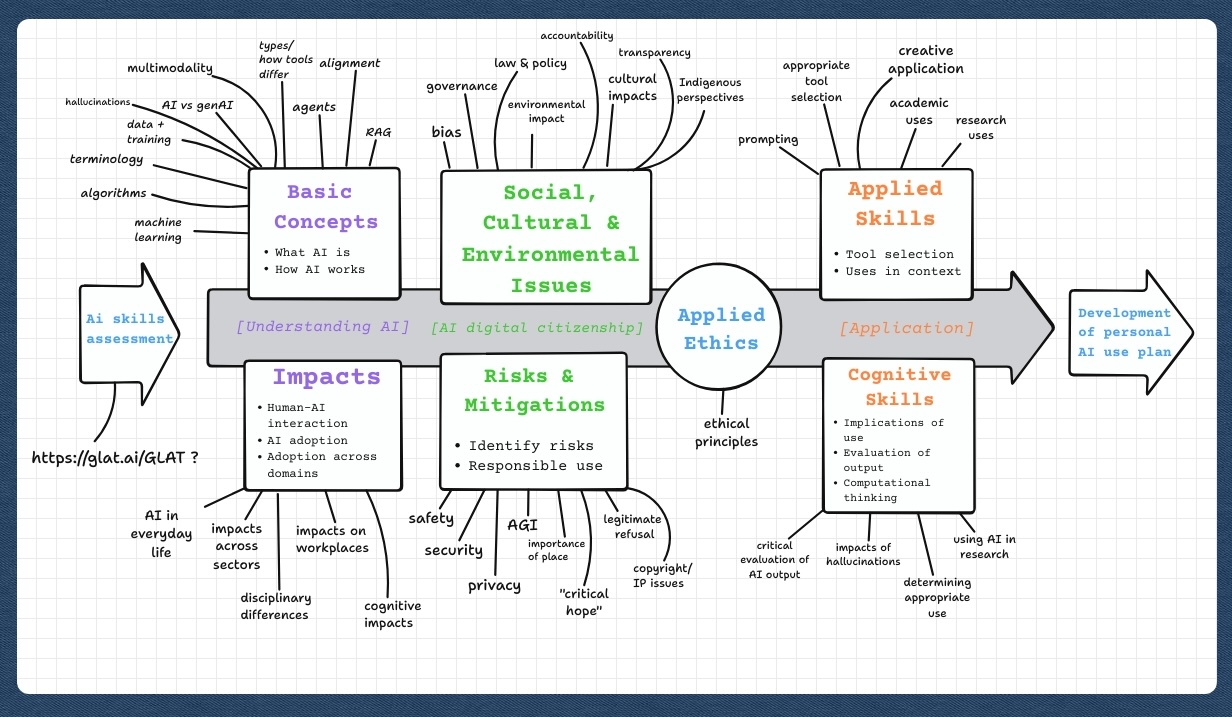
Drawing on the Scaffolded AI Literacy (SAIL) framework (MacCallum et al., 2024; MacCallum et al., 2026) I seek to develop learning experiences that address the full complexity of graduate-level AI engagement – including AI across the research lifecycle, applied disciplinary ethics, risks to scholarly integrity, environmental and cultural dimensions, and development of personal AI learning plans. I am also borrowing from Horst’s (2025) ‘entangled dimensions’ framing, and the competency and assessment literature (Annapureddy et al., 2025; Jin et al., 2025; Long & Magerko, 2020). I am adopting a deliberate ‘AI without tears’ pedagogical stance, with the goal of developing learning experiences that foreground metacognitive awareness, disciplinary specificity, and evaluative judgment alongside practical skills.
References
Almatrafi, O., Johri, A., & Lee, H. (2024). A systematic review of AI literacy conceptualization, constructs, and implementation and assessment efforts (2019–2023). Computers and Education Open, 6, 100173. https://doi.org/10.1016/j.caeo.2024.100173
Annapureddy, R., Fornaroli, A., & Gatica-Perez, D. (2025). Generative AI literacy: Twelve defining competencies. Digital Government: Research and Practice, 6(1), Article 13. https://doi.org/10.1145/3685680
Horst, R. (2025). The entangled dimensions of AI literacy. https://canvas.ubc.ca/courses/166966/pages/cultivating-ai-literacy
Jin, Y., Martinez-Maldonado, R., Gašević, D., & Yan, L. (2025). GLAT: The generative AI literacy assessment test. Computers and Education: Artificial Intelligence, 9, 100436. https://doi.org/10.1016/j.caeai.2025.100436
Long, D. L., & Magerko, B. (2020). What is AI literacy? Competencies and design considerations. Proceedings of the 2020 CHI Conference on Human Factors in Computing Systems, 1–16. https://doi.org/10.1145/3313831.3376727
MacCallum, K., Parsons, D., & Mohaghegh, M. (2024). The scaffolded AI literacy (SAIL) framework for education: Preparing learners at all levels to engage constructively with artificial intelligence. He Rourou, 1(1). https://doi.org/10.54474/herourou.v1i1.10835
MacCallum, K., Parsons, D., & Mohaghegh, M. (2026). The scaffolded AI literacy (SAIL) framework: Results of a Delphi study for equitable AI literacy framework design in education. Computers and Education: Artificial Intelligence, 10, 100584. https://doi.org/10.1016/j.caeai.2026.100584
Street, B. (1984). Literacy in theory and practice. Cambridge University Press.

